
Why AI-Native Systems Are Composed, Not Coded
AI-native systems assemble models, tools, constraints, and evaluators — not hand-written control flow. How to design for composition in production.
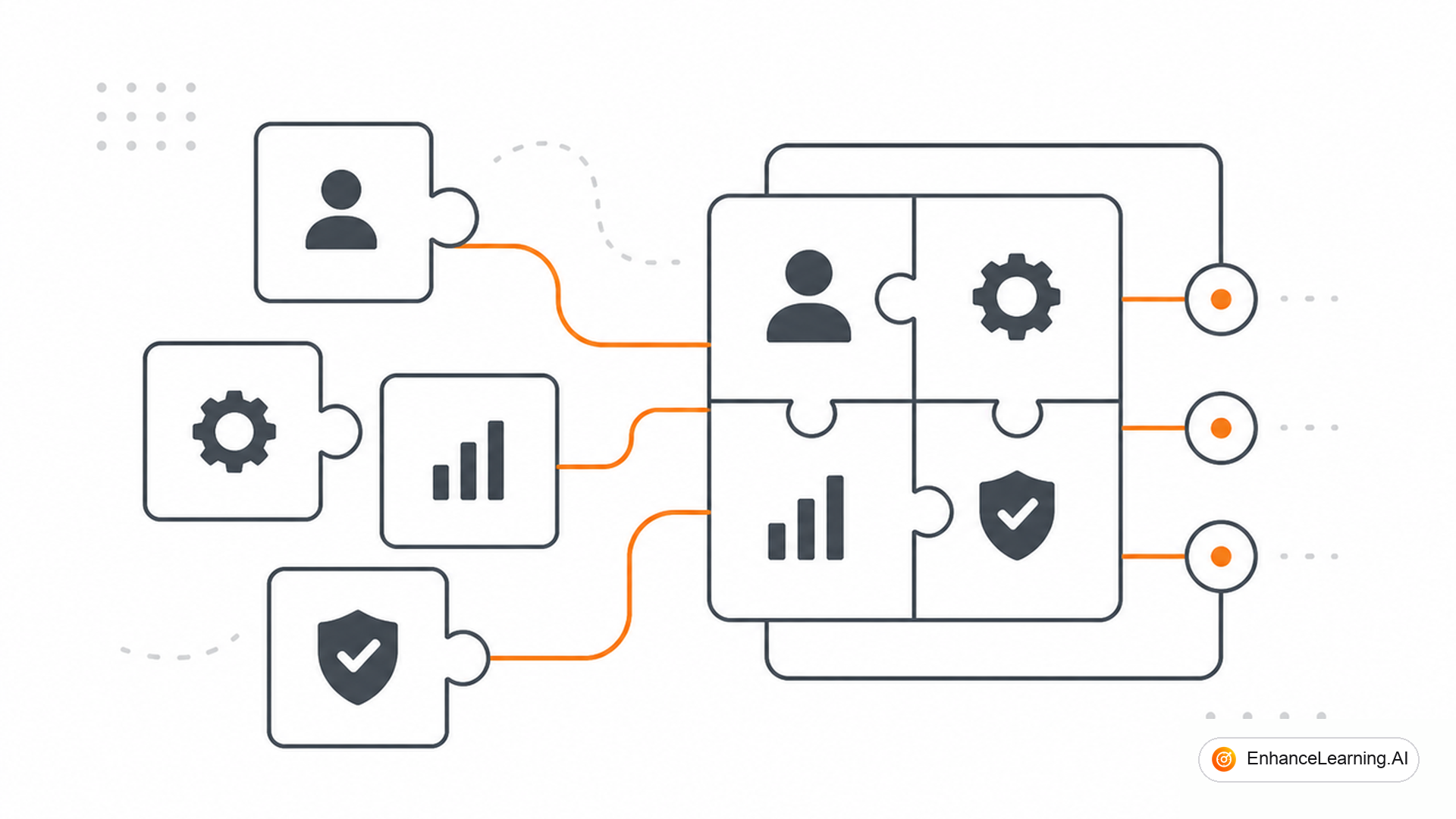
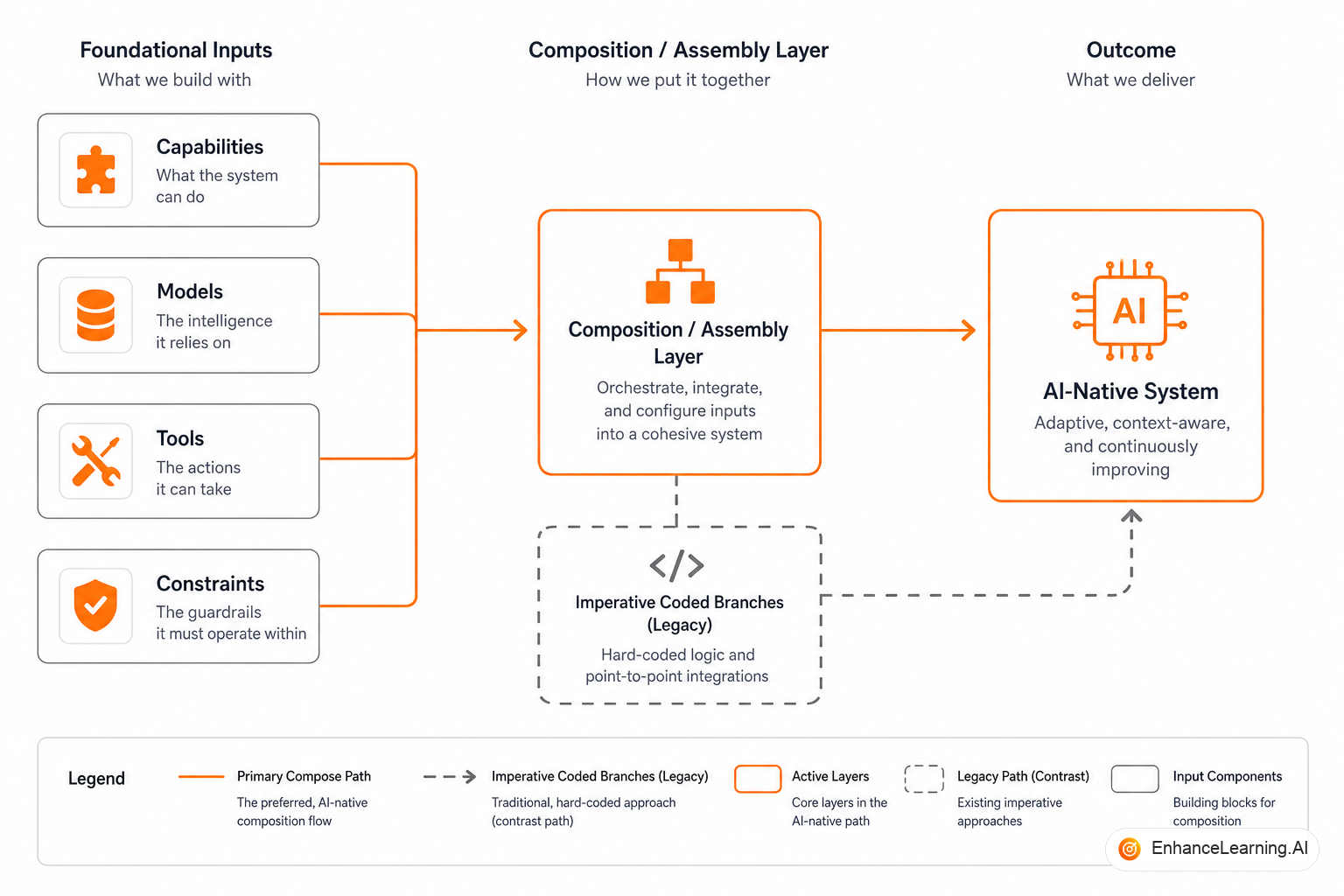
The instinct of a senior engineer facing a new workflow is to open the IDE and write the path: validate input, call service A, branch on status, persist, return. That instinct built reliable software for decades. It is the wrong default when the workflow's core decision — what to do next given messy language — belongs to a model. AI-native systems are not "less code." They are code in a different shape: imperative shells around composed capabilities, with the model selecting among options you define rather than logic you enumerate.
Teams that miss this distinction write five thousand lines of nested conditionals trying to anticipate every user phrasing, then add a model call at the bottom as cleanup. Teams that get it write three hundred lines of orchestration, six typed tools, two retrieval pipelines, and a prompt that describes goals — then spend their time on evals instead of branch coverage.
Imperative logic hits a wall with language#
Consider an internal IT helpdesk bot. The imperative version encodes intents: password reset, VPN issue, laptop request, access grant. Each intent has a handler. New phrasing ("I locked myself out of Okta again") requires a new regex or classifier label. Edge cases compound. Within six months the handler file is unmaintainable and still misses "my SSO is being weird."
The composed version defines capabilities: reset_password(user), check_vpn_status(user), create_ticket(summary), search_runbook(query). The orchestrator assembles context — user profile, recent tickets, relevant runbook chunks — and asks the model to choose tools until the task completes or a step budget expires. New phrasing often works without a deploy because the model maps language to existing capabilities. When it does not, you fix retrieval or add a tool — not another branch.
The shift is psychological. You stop asking "what are all the paths?" and start asking "what capabilities must exist, and what constraints wrap them?"
Composition primitives#
A production AI-native stack is usually built from a small set of repeatable parts:
| Primitive | Role | You own |
|---|---|---|
| Model endpoint | Language reasoning, planning, synthesis | Version pinning, fallbacks, cost caps |
| Tool / function | Side effects and authoritative reads | Schemas, authz, idempotency |
| Retriever | Grounding in docs, tickets, policies | Chunking, freshness, access control |
| Memory store | Durable facts across sessions | Extraction, TTL, privacy |
| Schema validator | Contract between model and code | Fail-closed behavior |
| Eval harness | Regression on trajectories and outcomes | Golden sets, thresholds |
None of these are novel infrastructure categories. The architectural decision is to treat them as interchangeable slots in a pipeline rather than as incidental helpers wrapped in application code.
The orchestrator is still code — and it should stay boring#
"Composed, not coded" does not mean no code. It means the code you write looks like infrastructure glue:
- Load and budget context
- Call the model with a structured output contract
- Validate and dispatch tools
- Append results and loop until done or capped
- Score and log the trajectory
That loop should be readable in one screen. If your orchestrator needs a wiki, you smuggled business rules back into imperative form — probably in prompt prose.
from pydantic import BaseModel, Field
from openai import OpenAI
from typing import Literal

client = OpenAI()

class ToolCall(BaseModel):
    name: Literal["search_runbook", "reset_password", "create_ticket"]
    args: dict

class Step(BaseModel):
    kind: Literal["tool", "finish"]
    tool: ToolCall | None = None
    answer: str | None = None

TOOLS = {
    "search_runbook": search_runbook,   # your impl
    "reset_password": reset_password,
    "create_ticket": create_ticket,
}

async def run_helpdesk(user_id: str, message: str, max_steps: int = 5) -> str:
    context = await assemble_context(user_id, message)
    trail: list[str] = []

    for _ in range(max_steps):
        step = await plan_step(context, message, trail)
        if step.kind == "finish":
            await score_trajectory(user_id, trail, step.answer or "")
            return step.answer or ""

        assert step.tool is not None
        result = await TOOLS[step.tool.name](**step.tool.args)
        trail.append(f"{step.tool.name}: {result}")
        context = await refresh_context(context, result)

    return "Escalated to human agent — step budget exhausted."
The imports point at real boundaries. The interesting design is what you put in assemble_context, plan_step, and score_trajectory — not in a tree of if intent == ....
Constraints replace branches#
In imperative systems, business policy lives in conditionals. In composed systems, policy lives in constraints the model cannot bypass:
- Allowlists — only these tools exist
- Schemas — tool args must validate before execution
- Budgets — steps, tokens, cost
- Authz gates — deterministic checks on every tool call regardless of model intent
Prompts describe goals and tone. They should not be the only line of defense for "never refund over $500." That rule belongs in code at the tool boundary, exactly where classical systems would enforce it.
Teams that conflate prompts with policy discover this painfully when a jailbreak or a bad retrieval chunk steers the model toward a tool it should never invoke. Composition without constraints is just a expensive random number generator with API access.
When composition beats coding (and when it does not)#
Composition wins when:
- Input language is open-ended but the action set is finite
- Requirements change weekly and branch maintenance would drown the team
- Quality is graded — "good enough" answers vary in wording
Imperative code still wins when:
- Rules are stable, auditable, and legally precise (tax calculation, eligibility)
- Latency must stay sub-50ms with no model call
- Every path must be provably covered by unit tests
The mature architecture mixes both: deterministic code for hard rules, composed loops for language-heavy surfaces. The mistake is using only one style because it matches your team's comfort zone.
List every user-facing workflow your team owns. For each, count the number of distinct "capabilities" (reads, writes, searches) versus the number of conditional branches you would need to cover phrasing variants. If branches dominate, you are fighting the wrong battle — invest in tools and retrieval first, not another intent enum.
Evals close the composition loop#
Composed systems change behavior when any primitive changes: model version, chunk size, tool latency, prompt wording. Without evals, composition feels fragile — because it is fragile without feedback.
Treat eval harnesses as part of the composed stack, not QA overhead. Golden trajectories ("given this ticket, expect these tools in roughly this order") catch regressions that unit tests miss. Outcome scores catch quality drift that integration tests miss.
Versioning composed stacks#
In imperative codebases, semantic versioning tracks API breaks. In composed stacks, compatibility is multidimensional:
- Model version bump may change tool-selection behavior without schema changes
- Retrieval index rebuild may change grounding without application deploy
- Tool schema v2 may break prompts that still describe v1 parameters
Release metadata should fingerprint the whole bundle: orchestrator git SHA, model ID, prompt hash, index version, eval suite ID. Rollback means rolling back the bundle — not just the container.
Production teams that version only the service binary learn this when "no code changed" incidents still shift user-visible behavior. Composition demands composition-aware release notes.
Anti-patterns that look like composition#
Prompt-as-orchestrator. Three thousand words of "if the user mentions X, call Y" is imperative logic in prose clothing. It will not get code review coverage and will not diff cleanly.
Tool sprawl without ownership. Fifteen tools with overlapping descriptions confuse the model and the on-call engineer. Merge reads, split writes, assign owners.
Retrieval as magic grounding. Dumping chunks without relevance thresholds and citation requirements is not composition — it is hope with embeddings.
Missing deterministic gates. Composition without authz on tools is an open API keyed by natural language.
Organizational fit#
Composition favors teams comfortable owning capability catalogs and eval suites more than giant handler classes. Platform engineers publish tools and schemas; product engineers assemble workflows; eval owners guard regressions. That split does not happen automatically in orgs optimized for feature branches in one monolith.
If your performance reviews reward lines of application code, composition work — thin orchestrators, fat contracts — will be underinvested until incidents force the issue. Adjust incentives before adjusting architecture.
Summary#
AI-native systems are composed, not coded, in the sense that control flow emerges from model choices among capabilities you provide — bounded by schemas, budgets, and policy gates you write in boring, testable code. The engineering craft shifts from enumerating paths to designing slots: tools, retrieval, memory, validation, evaluation. Teams that embrace that shift ship workflows that adapt to language without branch explosion. Teams that resist it drown in conditionals and still call the result "AI-powered."
Want premium architecture blueprints?
Be among the first to explore interactive reference architectures, implementation playbooks, and premium engineering resources at launch.
Related Articles
Recommended reading based on this topic.
The Hidden Coupling Between Prompts and AI System Architecture
Prompt length, role structure, and tool definitions leak into service boundaries, data flows, and API contracts — coupling teams thought was decoupled.
Read ArticleThe Architecture of Fallback in AI-Native Systems
When models fail or confidence drops, AI-native systems need layered fallbacks — rule engines, cached answers, human queues — not generic error messages.
Read ArticleWhy AI-Native Systems Need Different Failure Models
AI-native failures are graded — partial outputs, silent errors, confident wrong answers. Binary failure models miss the damage until trust is gone.
Read Article