
Why Evals Are the Foundation of Trustworthy AI-Native Systems
Probabilistic AI cannot earn enterprise trust without evaluation. Why evals are the prerequisite for shipping, scaling, and defending AI-native systems.
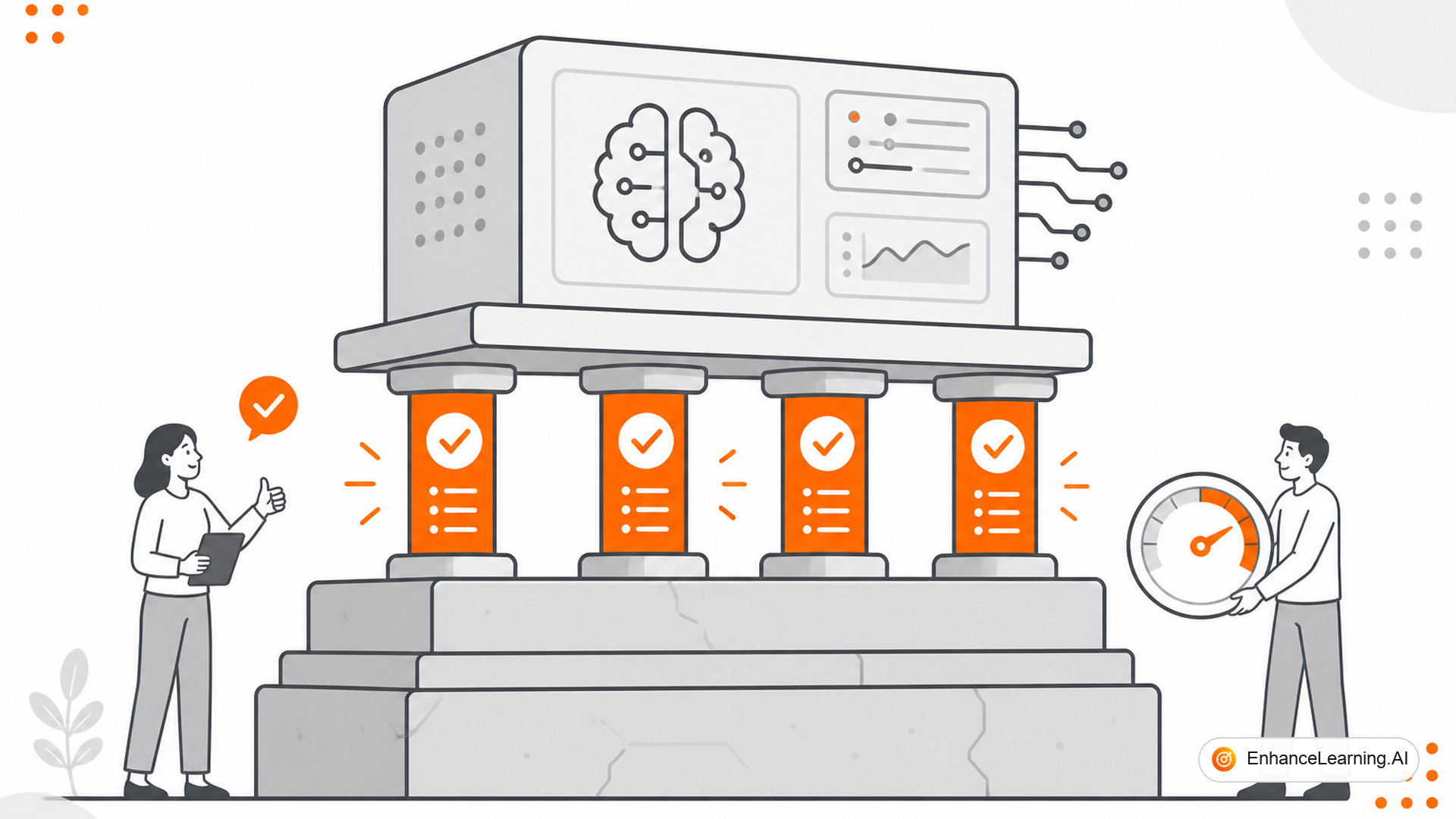
Enterprise buyers do not ask whether your model is impressive. They ask whether they can defend a decision made by your system in front of legal, compliance, and their own customers six months from now. That defense requires evidence — not a demo, not a leaderboard screenshot, not a product manager saying the answers "felt better." Evaluation is how engineering quality becomes enterprise trust. Without it, AI-native systems remain prototypes wearing production URLs.
Trust is a measurement problem, not a branding problem#
Traditional software earns trust through deterministic behavior: the same input produces the same output, tests prove invariants, and audit logs show who changed what. AI-native systems break that contract at the core. The model proposes language and actions; your platform constrains them. Users experience fluent outputs that can be wrong in subtle ways. Stakeholders who approve budgets and risk tolerance need a repeatable way to know the system is fit for purpose — today and after the next model bump.
Evals are that measurement layer. They translate fuzzy quality into signals you can trend, gate releases on, and explain to non-engineers. A team that ships without evals is not moving fast. It is moving blind and asking trust to accumulate by accident.
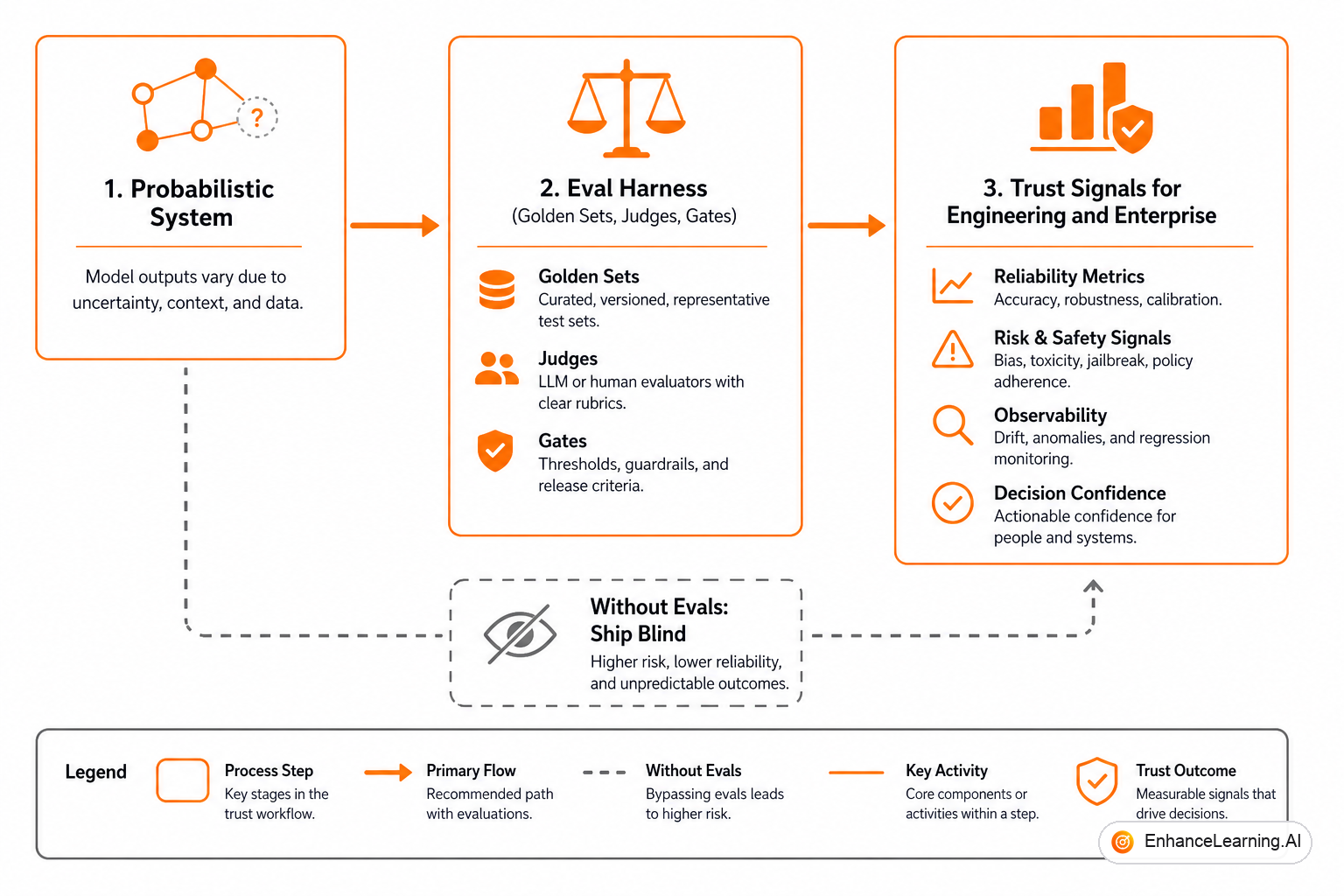
What "trustworthy" means in production#
Trustworthy does not mean perfect. It means predictable enough to operate, transparent enough to audit, and improvable when reality diverges from intent. For AI-native systems, that breaks into concrete dimensions:
| Dimension | What stakeholders need | What evals provide |
|---|---|---|
| Correctness | Answers grounded in approved sources | Faithfulness and citation checks |
| Safety | Refusal on out-of-scope or harmful requests | Policy and boundary case suites |
| Reliability | Stable behavior across releases | Regression gates on golden sets |
| Accountability | Trace from output to evidence | Linked eval cases and production samples |
| Cost discipline | Spend aligned with value delivered | Cost-per-successful-task metrics |
Notice none of these come from uptime alone. A system can be available and untrustworthy simultaneously — the classic "confident nonsense" failure mode.
Evals connect engineering to the boardroom#
Engineering teams naturally optimize for latency, error rates, and deploy frequency. Executive sponsors optimize for risk, adoption, and renewal. Evals sit at the intersection. When legal asks "how do you know the assistant won't invent contract terms," you point to a labeled refusal suite and weekly faithfulness sampling — not to prompt engineering heroics.
A healthcare SaaS vendor learned this the hard way. Their clinical documentation assistant shipped with strong latency metrics and enthusiastic pilot feedback. Three weeks after a silent embedding model update, faithfulness on medication interaction queries dropped — no HTTP errors, no alerts. Support tickets arrived before engineering noticed. The post-incident review did not blame the model vendor alone. It blamed the absence of eval gates tied to retrieval quality. Trust evaporated faster than the feature had earned it.
Treat evaluation results like a service contract between platform and product: defined inputs, scored outputs, versioned thresholds. When product changes behavior, they update the contract. When platform changes models, they prove the contract still holds.
Why demos and benchmarks are insufficient#
Demos select happy paths. Benchmarks measure isolated model capability on curated tasks. Neither proves your composed system — retrieval, tools, orchestration, guardrails — behaves acceptably on your data under your policies. A 92% MMLU score does not tell you whether your RAG pipeline cites the right policy paragraph for a specific tenant configuration.
Trustworthy AI-native systems require application-level evaluation scoped to job classes: support triage, contract summarization, code review assistance, internal search. Each class needs cases that reflect real constraints — must cite, must refuse, must call a specific tool — not paraphrases of benchmark questions.
Building evals as a prerequisite, not a retrofit#
Teams that treat evals as phase-two work usually never reach phase two. The feature ships, adoption grows, and retrofitting labels against live traffic feels like slowing momentum. The fix is cultural and structural: no promote without eval delta, same as no merge without tests.
Start narrow. One job class, fifty cases, three metrics: schema validity, faithfulness, task success. Run on every prompt or retrieval change. Expand when that loop is boring — boring means trusted.
from dataclasses import dataclass
from enum import Enum

class TrustSignal(str, Enum):
    PASS = "pass"
    FAIL = "fail"
    REVIEW = "review"

@dataclass
class EvalResult:
    case_id: str
    job_class: str
    faithfulness: TrustSignal
    policy_adherence: TrustSignal
    schema_valid: TrustSignal

def release_allowed(results: list[EvalResult], baseline: dict[str, float]) -> bool:
    """Block release when trust signals drop below agreed thresholds."""
    by_class: dict[str, list[EvalResult]] = {}
    for r in results:
        by_class.setdefault(r.job_class, []).append(r)

    for job_class, runs in by_class.items():
        pass_rate = sum(
            1 for r in runs
            if all(getattr(r, f) == TrustSignal.PASS
                   for f in ("faithfulness", "policy_adherence", "schema_valid"))
        ) / len(runs)
        if pass_rate < baseline.get(job_class, 0.95):
            return False
    return True
The code is simple. The hard part is agreeing that release_allowed returning False actually blocks the deploy.
Evals enable scaling without heroics#
Heroic prompt editing does not scale across teams, regions, or model migrations. Evals scale because they are data and automation. When you add a second product line, you clone the harness structure — runner, reporting, judge versioning — and attach a new golden set owned by that domain. Platform maintains the engine; domains maintain the contract.
Offline suites catch regressions you anticipated. Online sampling catches drift you did not. Trust compounds when users see quality hold steady across releases, not when marketing announces another "AI upgrade."
The cost of skipping evals#
Skipping evals feels cheaper for the first sprint. The bill arrives as emergency rollbacks, manual QA armies before every model change, sales deals stalled in security review, and engineers burning credibility with product partners. One fintech team spent six weeks rebuilding customer trust after a summarization feature started omitting fee disclosures — detectable on day one with a twenty-case golden set, invisible in aggregate latency charts.
Eval debt is like security debt. You can defer it until an incident makes the interest rate unbearable.
Summary#
Trustworthy AI-native systems are built on measurement, not hope. Evals connect probabilistic behavior to enterprise requirements: faithfulness, policy adherence, regression control, and auditability. Demos and benchmarks cannot substitute for application-level evaluation tied to release gates and production sampling. Treat evals as a shipping prerequisite — versioned, owned, and blocking — or trust will remain fragile no matter how polished the interface looks.
Want premium architecture blueprints?
Be among the first to explore interactive reference architectures, implementation playbooks, and premium engineering resources at launch.
Related Articles
Recommended reading based on this topic.
Why Reproducibility Matters in AI Evaluation Pipelines
Eval results you cannot replay are opinions. Seed control, environment pinning, and auditable artifacts make evaluation pipelines trustworthy.
Read ArticleWhy Enterprise AI Operating Models Need Periodic Redesign
Enterprise AI operating models must evolve with capability, maturity, and priorities — not stay frozen after a one-time setup.
Read ArticleModel Selection Framework for Enterprise AI
A practical framework for choosing enterprise models: task fit, context and tool needs, cost-latency envelopes, eval gates, and when to use routers instead of one frontier model.
Read Article